As promised during my talk at BSides Birmingham on 16th May 2026, here is the content from my talk on the Full-Stack Human, and why a non-linear technical career builds better systems.
Opening
The Full-Stack Human
Why a Non-Linear Technical Career Builds Better Systems
BSides Birmingham 2026
If your career feels like Spaghetti Junction…
 …this talk is for you
What you’ll leave with
- 5 muscles you can train, regardless of current role
- 1 playbook for moving from reactive to proactive
- 1 mindset shift for why generalism is a security superpower And sports analogies…
The Scenic Route in 30 Seconds
A career is a training plan, not a ladder
- Support
- Professional Services
- Technical Pre-Sales
- Developer Relations
- Architecture

Muscle 1: The Detective
Every error message is a user interface.

- The pattern: 3am on-call, alert fatigue
- In security: SOC triage, incident response under pressure
- Train it Monday: shadow an on-call shift, sit with your SOC for an hour
From the speaker notes
- Years watching things break in the wild
- Root-cause thinking = design philosophy, not just outage skill
- “Supported it → build it observable by default”
- “Can you ping it?” → systems should self-diagnose
Muscle 2: The Builder
“It works on my machine” is not a threat model.

- The pattern: gap between design doc and the real environment
- In security: paper controls vs pen test reality
- Train it Monday: deploy one of your own changes to prod, end-to-end
From the speaker notes
- Unknown assumptions, unwritten rules, defaults — they bite
- Beautiful InfoSec policy ≠ real environment
- Consult: educate, explain, propose
- Not the decision-maker? You can still influence
Muscle 3: The Storyteller
Architecture is 80% people, 20% code.

- The pattern: great technical ideas dying in boardrooms
- In security: mapping CVEs to business continuity risk to get controls funded
- Train it Monday: pitch one security project to a non-technical stakeholder
From the speaker notes
- Techies called it “the dark side”… then I joined
- Best technical solution is worthless if you can’t sell it
- Security: can’t convince a stakeholder why a control matters → no funding
- “Storytelling is a technical requirement”
Muscle 4: The Translator
Friction is the enemy of security.

- The pattern: tools no one uses, docs no one reads, policies people bypass
- In security: pasting secrets into Slack because your vault is hard
- Train it Monday: write the README for your own security tool, like a developer would
From the speaker notes
- DevRel Sounds niche — but hear me out
- Tooling only as good as community’s ability to use it
- Friction → smart people route around → control + shadow process (worse!)
- Empathy is a control surface, not a soft skill
- Black Hat firewall automation: only I used it → democratised UI → team adoption + accuracy + speed
Muscle 5: The Architect
Stop working tickets. Start spotting patterns.

- The pattern: the reactive loop - alerts, tickets, fire-fighting
- In security: defense in depth requires whole-system view
- Train it Monday: pick one repeating alert and propose its replacement
From the speaker notes
- Not coding, not on-call, not configuring firewalls
- See the whole system: humans, processes, business risk
- Think bigger picture
The Cross-Training Effect

From the speaker notes
- 1 muscle SOLVES a problem
- 2 muscles UNLOCK an opportunity
- All 5 build a career hard to replace
- Runners: not faster by only running, or only hamstrings — cross-train (swim, cycle)
- Engineers: not senior by only writing code; security pros not by only firewalls / endpoint / pen test
- The COMPOUNDING effect is the point
From Whac-A-Mole to Approved
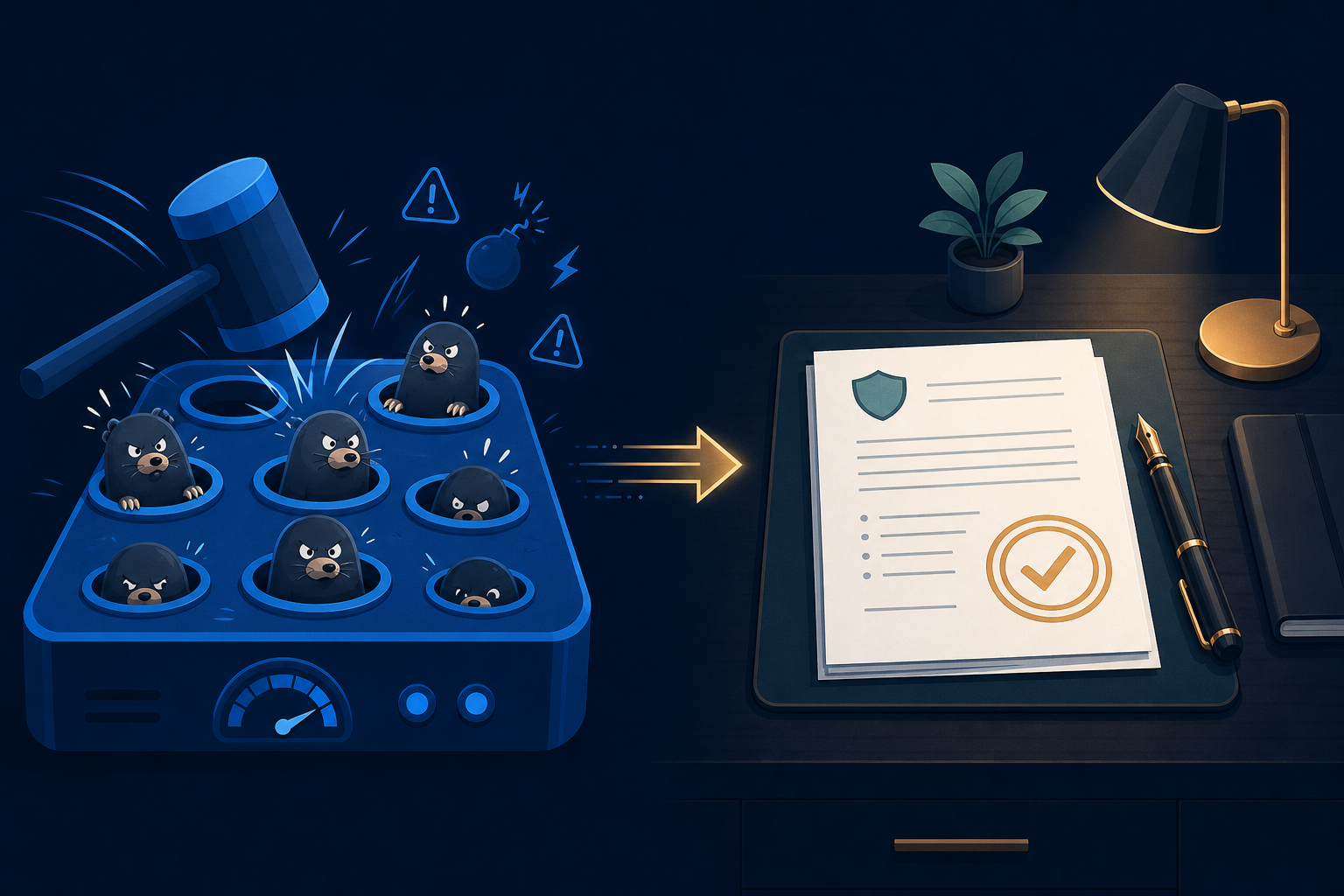 I stopped waiting for “tickets”
How?
I stopped waiting for “tickets”
How?
From the speaker notes
- 15 yrs reactive: tickets, boss, PMs, “the business” told me what to do
- Shift is not technical — it’s behavioural
- Permission you give YOURSELF
The Proactive Playbook
- Identify the pattern - The Detective spots the repeating failure
- Build the prototype - The Builder + The Architect ship a small, ugly version
- Sell the solution - The Storyteller + The Translator make it the new standard
From the speaker notes
- 1: Detective → spot repeating failure (support already trained you)
- 2: Builder + Architect → small ugly PoC (especially with AI)
- 3: Storyteller + Translator → make it the new standard
- Recent: SOC detection-rule dedup → PoC → demo’d → into prod in 2 weeks
The Confidence Dip
 The dip is the cost. The climb is the muscle. However…
From the speaker notes
- “Confidence drops before it climbs”
- “Every domain pivot felt like starting from zero”
- Without this slide → talk = victory lap
- Cost of generalism: imposter syndrome — not saying it’s easy
- Knowing nothing again / wondered if mistake / jealous of ladder paths
- “However…” → bridge to next slide
You already have the muscle
| What you call it | What architects call it |
|---|---|
| Ticket triage | Resilience and fault tolerance |
| Customer workshops | Stakeholder alignment |
| “Just write the docs” | Developer experience |
| Bug reproduction | Threat modelling |
| Runbooks | Operational design |
From the speaker notes
- Everyone in the room has muscle they don’t credit themselves for
- Reframing vocabulary unlocks progress
May 2026: AI democratises execution. Not judgement.
- LLMs win at narrow artifacts
- Judgement lives across the stack
- Generalist territory
- Integration compounds
From the speaker notes
- Skilling up with AI = a given, widely covered
- LLMs WIN narrow: Sigma rule · YARA sig · IAM policy · Terraform module
- LLMs DON’T have: threat model · risk appetite · data classification · team maturity
- That’s where the generalist comes with the answers
- Integration muscle (experience + scars) compounds harder than execution skill
Generalism is a Security Posture
Attackers move across the whole system. Defenders cannot afford silos. For example…
From the speaker notes
- NOT a weakness to apologise for — it’s a DEFENSIVE REQUIREMENT
- Siloed DBA / network engineer / app dev = tunnel-vision specialist
- Threat model spans the whole system
- JLR (down the road, £1.9bn, GDP impact): IT/OT generalist oversight? helpdesk ↔ identity boundary? — weak points
- M&S incident: similar traits
The Final Four
- Don’t rush to specialise
- Collect muscles, not certifications
- Speak Bash and Business
- Stop waiting for permission
From the speaker notes
- “Four things for Monday.”
One last thing
The most complex system you will ever build, is your own career. Build it generalist.